How to Choose a PoE Switch for Surveillance, Wi-Fi, and Technical Installations?
Now that you already know what a PoE switch is and what it is used for, it is time for a more difficult question: which one should you choose? There are dozens of models on the market at very different prices and with very different specifications. Some are perfect for an office, others are suitable only for a cabinet in an air-conditioned server room, and still others can handle an outdoor box by the roadside in the middle of winter. The difference between them is significant, and it is worth understanding before making a decision.
Number of PoE ports, or how many devices you can connect
This is the first and most obvious criterion, but it is worth approaching it thoughtfully. The rule is simple: count the devices that need to be powered over the network and add some room for future expansion.
In a small office installation with a few cameras and one access point, a switch with four or eight PoE ports will be enough. In a larger facility, where there are a dozen cameras and several access points, a model with eight ports or more will make more sense.
It is also worth remembering that not every port on a switch has to be a PoE port. Many models have eight PoE ports and additionally two or more uplink ports through which the switch connects to the rest of the network. This configuration is very practical, and I will discuss uplink ports separately in a moment.
One practical tip: do not buy a switch with exactly as many ports as you need today. Installations tend to grow, and a missing port halfway through a project can easily keep you awake at night.

PoE power budget, the most important parameter that half of buyers forget about
The number of ports is one thing, but the PoE power budget is a parameter that in practice is even more important and much more often overlooked when purchasing.
The power budget is the total number of watts that a switch can simultaneously deliver to all connected devices. And this is where the kind of math you cannot ignore begins.
Let us assume you have a switch with eight PoE ports and a 65W power budget. You connect eight cameras, each drawing 12W. That adds up to 96W, and the switch simply cannot power all of them at the same time. It will start disabling subsequent ports or limiting power, and the cameras will behave unpredictably.
That is why before buying, it is always worth adding up the power consumption of all the devices that are meant to be powered and comparing it with the switch’s power budget. It is a good idea to add a 20–30% margin to the result, because devices often draw more power during startup than during normal operation.
The power budget also depends on the PoE standard supported by the switch. Basic PoE (802.3af) provides up to 15.4W per port, PoE+ (802.3at) up to 30W, and PoE bt (802.3bt), also called PoE++, can deliver as much as 60W or 90W to a single port. For installations with modern PTZ cameras, Wi-Fi 6 access points, or devices that require truly high power, the PoE bt standard stops being a luxury and becomes a necessity.
When are uplink and SFP ports useful?
Most PoE switches, in addition to power-supplying ports, also have several extra non-PoE ports intended to connect to the rest of the network or to an upstream switch. These are the uplink ports.
In simple installations, one uplink port with a twisted-pair cable to the router or the main switch is enough. But there is one problem: twisted-pair cable has a limited range. Standard Ethernet over twisted pair works properly only up to 100 meters. If the cabinet with the switch is farther away, another solution is needed.
That is where SFP ports come in. SFP is a type of slot into which you insert a replaceable optical or copper module, depending on your needs. Fiber modules allow transmission over distances measured in kilometers, without any loss of speed or signal quality.
For large-scale installations such as surveillance across a factory site, school campus, residential estate, or municipal infrastructure, SFP ports change everything. Instead of looking for compromises and working around the issue with separately purchased media converters, a switch with built-in SFP ports supports long-distance connections right out of the box.
Two independent SFP ports are now standard in decent industrial switches and light industrial solutions. They provide flexibility in selecting modules and the ability to run connections in two different directions at the same time.

What is the difference between an office switch and a solution for demanding applications?
This is a question where many people make a mistake. An office switch costing a few hundred złoty looks similar in a photo to an industrial switch costing several times more. In reality, the differences are fundamental and become apparent precisely when conditions stop being ideal.
An office switch is designed to operate in an enclosed room, at room temperature, with stable power from a 230V outlet. It works perfectly in a server rack or under a desk. But take it outside into a telecommunications cabinet next to a municipal surveillance pole, and problems will begin with the very first freezing winter.
A switch for demanding applications, often referred to as light industrial or simply industrial, is designed on the assumption that conditions will be harsh. The differences begin with the operating temperature range: where an office switch fails at just a few degrees below zero, an industrial model works flawlessly from -25°C to 65°C or even across a wider range.
Another difference is power supply. Industrial switches often have a DC input instead of, or in addition to, a standard power adapter, and they support redundant dual power supplies. If one power source fails, the other immediately takes over the load and the devices keep running. In critical installations, where a camera must record continuously, this is not an extra bonus but a requirement.
Then there is the issue of mounting. Industrial switches have an integrated DIN rail mount, which is the standard in automation cabinets and outdoor enclosures. An office switch in such a cabinet is a mounting problem and an invitation to accidental damage.
Finally: the enclosure. A solid metal construction dissipates heat better, protects the electronics better, and simply lasts longer in harsh conditions.
The most common mistakes when choosing a PoE switch
Over the years, several mistakes have become common and keep recurring, both among people buying equipment for the first time and among experienced installers working under budget pressure.
The most common one is buying a switch with an insufficient power budget. The switch has eight PoE ports, so the buyer assumes it will be enough for eight devices. Yes, but only if the total power draw of those devices fits within the wattage budget. PTZ cameras, Wi-Fi 6 access points, and other demanding devices can quickly challenge that assumption.
The second mistake is buying a cheaper office switch for an outdoor or industrial installation. The apparent savings at the time of purchase turn into real costs in the form of failures, repairs, and service trips. A switch that fails during the first heatwave or the first frost is no savings at all.
The third is ignoring SFP ports when planning large-scale installations. Someone assumes that twisted-pair cable will reach 120 meters because “it almost always works.” In practice, twisted pair beyond 100 meters means random transmission issues that are difficult to diagnose and frustrating to eliminate.
The fourth mistake is leaving no spare ports. The installation grows, and after a year it turns out there is no room for additional devices. Buying a switch with only a small port reserve often means replacing the entire device instead of simply expanding the system.
The fifth, discussed less often, is failing to take redundant power into account in places where continuity of operation is critical. Surveillance in a bank, an airport security system, or at the gate of a production plant cannot simply stop working because one power supply fails.

How do you combine all of this when choosing a specific model?
A good PoE switch for more serious applications should bring together several features at once: an appropriate power budget matched to the planned devices, support for higher PoE standards if the installation requires high power per port, SFP ports if the installation is large-scale, and suitable resistance to environmental conditions if the switch is not going into an air-conditioned server room.
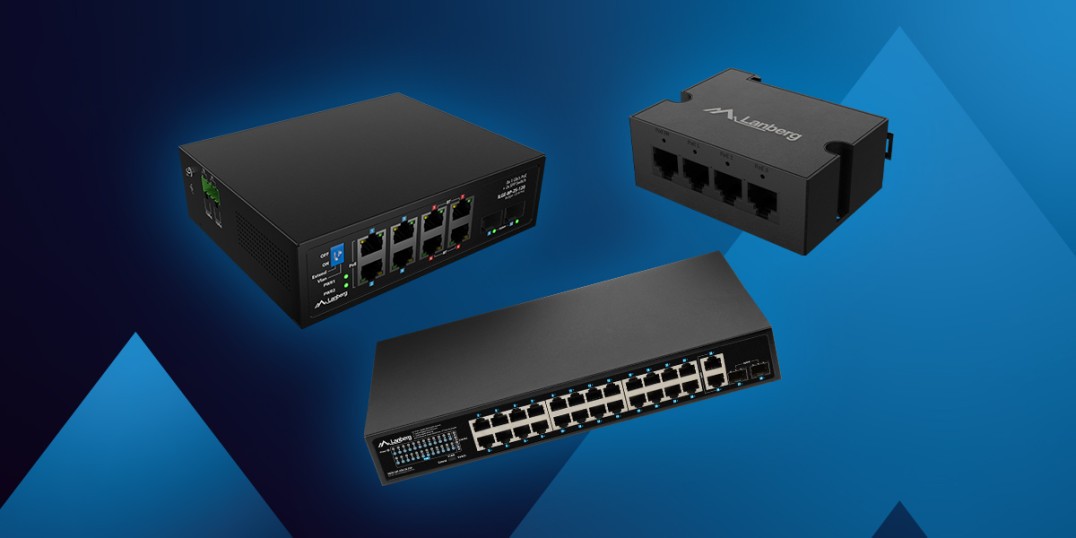
The market now offers models that combine all of these features in a compact enclosure designed for DIN rail mounting. The light industrial segment, which for years was a niche for large integrators, has also become available for smaller installations and single deployments.
It is precisely in this segment that Lanberg is preparing its response to the needs of modern installers, and we will write more in the next article about the specific solution that results from these assumptions.


